Case Brief or Margin Map: Choose by the Question
Choose a case brief or margin map to retrieve a judgment’s structure or trace how its legal reasoning connects, with a format matched to your study task.

Your judgment is open beside a blank page, and a seminar question asks why the court reached its result. A case brief or margin map can help, but each answers a different need: a brief makes a compact reference, while a map shows how claims and qualifications relate.
What will you need to find later?
A case brief organizes a judgment under headings such as procedural history, material facts, issue, rule, reasoning, and holding. It gives each part a clear place, so you can retrieve the decision’s structure without searching through every passage.
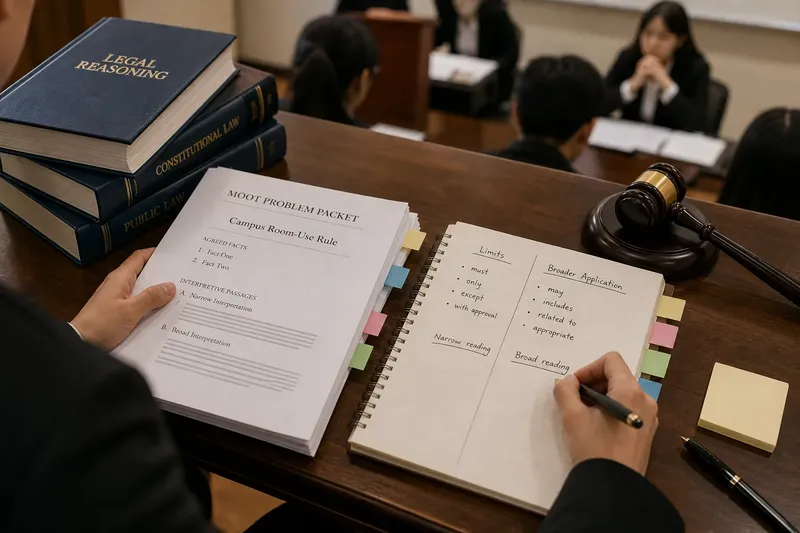
A margin map, by contrast, records connections across passages. It can show how a qualification narrows a claim, how a distinction affects an argument, or where the opinion raises a question you have not resolved.
Think of the difference as a compact index versus a visual trail through the reasoning. Choose the format according to what you will do with the judgment later.
When does a case brief fit?
Choose a case brief when you need to explain the decision’s main parts: what question the court addressed, what principle it applied, how it reasoned, and what it decided. Consistent headings also make it easier to compare judgments assigned in the same course.
Keep the brief selective. Include a fact if it helps explain the legal question or the court’s application of a rule. Leave background details in the judgment when they do not help answer your study question.
Use these prompts, adapting them when a decision does not fit a simple template:
- Procedural history: Check what earlier stage brought the dispute before this court. If that stage affects the question now being considered, include it; otherwise, note only the relevant procedural context.
- Material facts: Check which facts matter to the legal question or its application. If a fact shapes the analysis, record it; otherwise, leave it out of the brief.
- Issue: Check what legal question the court needed to answer. If the opinion resolves distinct questions, list them separately; otherwise, state the central issue.
- Rule: Check which legal principle or standard the court applies. If the opinion uses distinct rules, keep them separate; otherwise, record the relevant rule in the court’s terms.
- Reasoning: Check how the court connects its legal principle to the facts and arguments. If a qualification or alternative ground matters, note it; otherwise, summarize the main path of reasoning.
- Holding: Check the court’s answer to the issue. If it answers separate issues differently, record each answer; otherwise, state the result on the central issue.
These headings are prompts, not boxes to fill at any cost. If an opinion has separate opinions, several issues, or reasoning that does not divide neatly into rule and application, preserve those distinctions rather than flattening them.
When does a margin map help?
Choose a margin map when your question concerns relationships among parts of the reasoning. Instead of retelling the judgment in the same sequence, mark the connections that matter to your analysis.
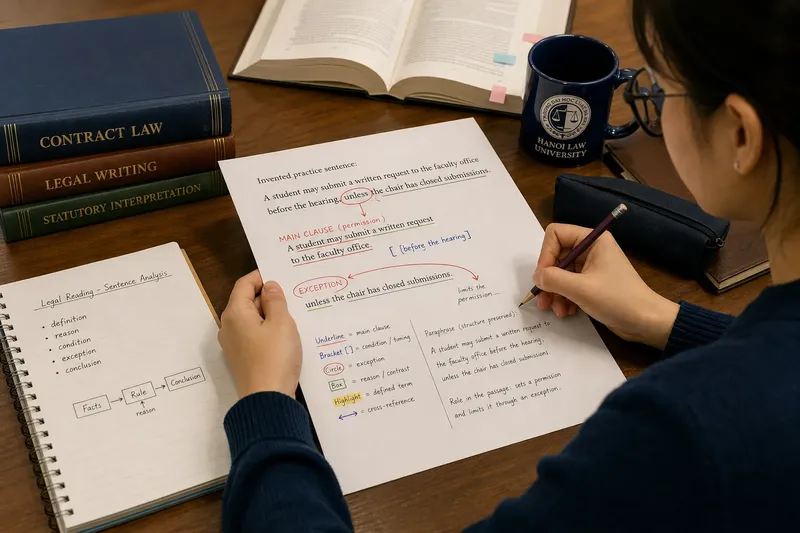
On a printed judgment, use pencil or removable tabs. In a PDF, comments, highlights, and drawing tools can serve the same purpose. Add brief labels such as “supports,” “limits,” or “question,” and connect only passages relevant to your task. Follow course or library rules for shared and borrowed copies.
A map does not need to track every paragraph or reproduce the text’s order. It can gather a claim from one part of the opinion beside a qualification that appears later. Page or paragraph references keep the connection easy to check against the judgment.
Which format fits your task?
- You need to explain a decision in class: Check whether you need to state its issue, rule, reasoning, and holding. If you do, write a brief; if one connection in the reasoning is unclear, map that passage before summarizing it.
- You need to compare judgments: Check whether your comparison uses the same parts of each decision. If it does, brief them with consistent headings; if the comparison concerns how arguments connect, map the relevant passages.
- You cannot see how the court reached its result: Check whether a distinction, factual link, or qualification is missing from your account. If one is unclear, map the related passages; if the path is already clear, record it in the brief.
- The opinion has more than one line of reasoning: Check whether alternative or separate reasoning affects your question. If it does, map the relationships; if it does not, a brief may capture the structure you need.
- You need a revision reference: Check whether you can state the issue and holding accurately. If you can, make a brief; if you cannot, return to the relevant passages before compressing them.
- You need to assess an argument: Check whether a premise, distinction, or inference needs closer attention. If it does, map the relevant passages; if the argument is clear, note the point in the brief.
Say you are preparing for class on an invented judgment with one central issue: whether a fictional licensing rule applies to a fictional student publication. The imagined text has three relevant passages: a paragraph stating the rule, a paragraph describing distribution to a small group of readers, and a paragraph limiting the rule where circulation is restricted. First, underline the rule passage and label it “claim.” Next, mark the distribution passage “application” and the limiting passage “qualification.” Draw a line from the qualification to the rule, then add references to each passage beside the labels. The resulting map makes the relationship visible: the court’s analysis turns on the stated distribution and the qualification, not just the broad rule. For the brief, write the issue as whether the rule applies, list the rule and distribution facts, record the qualification under reasoning, and state the fictional holding as “the rule does not apply on these stated facts.” The tradeoff is that the map preserves the connection, while the brief gives you a compact account to scan.
How can you use both without duplicating notes?
Use both only when they answer separate needs. A map can make a relationship visible; a brief can provide a compact account of the decision’s parts. Copying the same explanation into both does not clarify it.
If the reasoning is uncertain, map the relevant connections first, then write a brief once you can describe the decision’s structure. If you already have a brief and later notice a significant qualification, add a focused map of that relationship instead of rewriting every note.
Link both records to page or paragraph references. Those pointers let you check your interpretation in context. Notes support close reading; they do not replace the court’s wording.
What questions help you choose a format?
Can a margin map replace a case brief?
It can be your main note when the task is to trace relationships among parts of the reasoning. If you also need to retrieve the issue, holding, or procedural history quickly, a brief may be more direct.
Can a case brief show the court’s full argument?
A brief can summarize reasoning, but its headings may not make connections among passages easy to see. If those connections matter to your question, add annotations or make a focused map.
Should you brief every judgment you read?
Not necessarily. Brief a judgment when you need a reusable account of its structure; annotate it when you are studying a particular argument. For a narrow question, a few relevant notes may be enough.
How should you handle separate opinions?
Keep each judge’s reasoning distinct rather than blending it into one account. A brief can identify the court’s holding and separate opinions, while a map can show where their arguments diverge.
How can you keep your notes focused?
Before writing, finish this sentence: “I will need these notes to…” If the answer is “state the issue, rule, and holding,” choose a case brief. If it is “show how the court connects or limits its claims,” choose a margin map. If both needs matter, map the relevant reasoning and then brief the decision.
Stop when your notes answer the question you started with. A brief should not become a miniature copy of the judgment, and a map should not turn every sentence into a symbol. For a case brief or margin map, choose the format that makes your next reading task clearer and lets you check your interpretation against the text.