How to Read the Work a Legal Sentence Does
Learn sentence-level legal reading by tracing how legal sentences organize clauses, exceptions, and emphasis, so you can explain their structure without losing the argument.
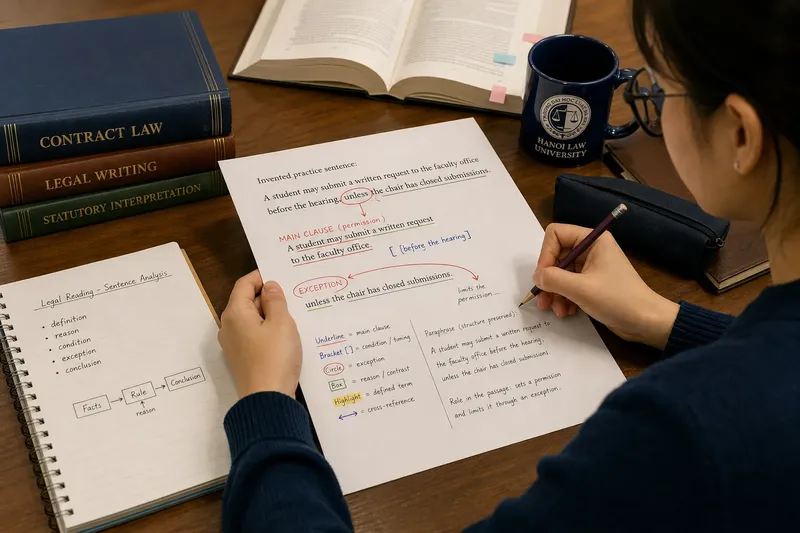
A student in a Trường Đại học Luật Hà Nội (HLU) seminar circles “unless” in a course handout, then draws a line from the word to the clause it changes. Sentence-level legal reading helps make that kind of structure visible: not just what a legal sentence permits or requires, but how its parts guide a reader through an argument.
This is a useful skill for studying statutes, judgments, contracts, and classroom materials. Rather than treating every sentence as a miniature rule, ask what job it performs in the passage: does it define a term, set out a condition, give a reason, or mark an exception?
What does a legal sentence contribute to an argument?
A legal sentence can do more than announce an outcome. It may introduce a concept, connect evidence to a conclusion, limit a claim, or explain why a decision follows from earlier material. Identifying that role helps you see the shape of the reasoning without reducing the passage to a list of isolated instructions.
Start with the surrounding paragraph. A sentence that begins with “therefore” may draw a conclusion from what came before; “however” may mark a qualification or contrast. Those signals are clues, not automatic answers. Read the nearby sentences to see what claim is being supported or limited.
In class notes, you might label a sentence “definition,” “reason,” “exception,” or “conclusion.” Keep the label brief and revise it if the larger passage points elsewhere. The purpose is to track the author’s movement, not to force each sentence into a fixed category.
How can you see the structure inside a sentence?
Look for the main clause first: the central statement that can often stand on its own. Then identify subordinate clauses, which depend on that statement, and connectors that show how the parts relate. A phrase such as “if the notice is received” may set a condition; “because the record is incomplete” may give a reason.
Try a simple markup method with a printed page or a PDF reader such as Adobe Acrobat. Underline the main clause, put brackets around conditions and exceptions, and draw an arrow from a connector to the phrase it links. If you are working on paper, use a pencil so the marks can change as your reading develops.
- Main claim: Underline what the sentence asserts; if it is difficult to identify, read the sentence aloud and set aside introductory phrases temporarily.
- Condition: Bracket phrases introduced by words such as “if” or “when”; if the phrase limits the claim, keep it attached in your paraphrase, and if its reach is uncertain, mark the ambiguity.
- Exception: Circle words such as “unless” or “except”; if they alter the main clause, show the altered relationship, and if the attachment is unclear, preserve the competing readings.
- Reason or contrast: Box connectors such as “because” or “however”; if they signal a reason or contrast, note what they connect, and if the connection is unclear, return to the neighboring sentences.
- Defined term: Highlight a term that is expressly defined elsewhere; if the passage points to that definition, consult it, and if no definition is supplied in the material, avoid inventing one.
- Cross-reference: Mark a reference to another section or document; if it directs you to material you have, read it alongside the sentence, and if you do not have it, record that limit before drawing a conclusion.
These marks help you follow the passage’s architecture. They do not decide the meaning by themselves; the surrounding text and relevant legal context still matter.
Why do connectors change the reading?
Connectors tell readers how to relate ideas. “And” joins elements, while “or” can present alternatives. “Unless” introduces an exception, and “because” typically introduces a reason. The exact effect depends on the sentence and its context, so treat each word as a cue to inspect the relationship rather than as a shortcut to a settled interpretation.
Consider a sentence with two conditions joined by “and.” The wording may ask the reader to consider them together. If “or” appears instead, the sentence may set out alternatives. To avoid losing that distinction, keep the connector in your paraphrase rather than replacing it with a looser phrase such as “the conditions.”
Sentence structure can also affect emphasis. A long qualification placed at the end may narrow the preceding claim, while a clause placed at the beginning may frame what follows. Notice the placement, then check whether the rest of the passage confirms that reading.
What questions help with sentence-level legal reading?
What is the main clause?
Find the central statement and distinguish it from introductory material or dependent clauses. If the sentence remains hard to parse, temporarily set aside modifiers, then add them back one at a time.
What does “unless” connect?
Identify the exception and the part of the main clause it qualifies. If the link could reasonably attach to more than one part, note both readings instead of choosing one without support from the passage.
How do I handle an unfamiliar legal term?
Check whether the text defines the term or points to a statute, judgment, or other source that does. If the material does not resolve its meaning, ask an instructor or consult an appropriate legal resource rather than relying on everyday usage alone.
When is a classroom reading not enough?
If an actual dispute, deadline, or decision affecting legal rights is involved, consult a qualified legal professional. A classroom exercise can help clarify sentence structure, but it cannot assess the full circumstances of an individual matter.
How does a worked reading follow a sentence’s logic?
Imagine an invented seminar handout contains this sentence: “A student may submit a written request to the faculty office before the hearing, unless the chair has closed submissions.” It is a fictional practice sentence, not an HLU rule. Its parts can be tracked without guessing what the faculty office would do.
- Starting text: The sentence contains one main permission, one specified action, one recipient, one timing phrase, and one exception. Copy it exactly so the wording remains available as you analyze it.
- Mark the main clause: Underline “A student may submit a written request to the faculty office before the hearing.” This identifies the permission and its stated details, but does not say that the request will be accepted.
- Attach the timing phrase: Bracket “before the hearing.” The sentence places a time limit on submission, while leaving the method of submission unstated.
- Mark the exception: Circle “unless the chair has closed submissions.” The exception qualifies the permission; if submissions are closed, the sentence does not provide that permission, while if they are not closed, the stated permission remains subject to the other wording.
- Record what is missing: Note that the sentence gives no response procedure and does not identify a filing method. Do not supply either detail from assumption.
The resulting reading is: the fictional sentence permits a student to submit a written request to the faculty office before the hearing, except when the chair has closed submissions; it does not state how the office responds. That account follows the sentence’s structure while leaving its unaddressed procedure open.
How can you make a paraphrase clearer?
A good paraphrase preserves the sentence’s relationships, not just its topic. After drafting one, compare it with the source and check each connector, condition, and exception. If the paraphrase removes “unless,” for instance, it may erase a limit that the original text makes explicit.
For a HLU seminar note, try writing two lines: first, a paraphrase of the sentence’s function in the argument; second, a question about any point the passage leaves open. This separates what the text contributes from what you still need to discuss, without turning an unresolved issue into an invented rule.
Sentence-level legal reading is most useful when it helps you explain how a passage works: which claim it advances, what qualifies that claim, and how it connects to the next part of the argument. Keep the original wording nearby as you revise your paraphrase; a small connector can carry more of the reasoning than a broad summary reveals.