How to Read the Scope of a Legal Definition
Learn how to read a legal definition’s scope, mark what it includes and excludes, and separate a document’s meaning from ordinary usage in class.

A student at Trường Đại học Luật Hà Nội (HLU) sees “visitor” in a campus rule and wonders whether it covers a guest lecturer. Reading a legal definition means checking how the document uses that label, not relying on a dictionary alone. The practical task is to identify what the wording covers and where its reach stops.
What does a legal definition do?
A definition assigns a stated meaning to a term for a document, subject, or provision. It can help readers apply the document’s language consistently, but it does not automatically change the word’s ordinary meaning or its use in another instrument.
For legal study, treat a definition as part of the document’s design. Ask what distinction it makes: who may use a service, which materials count, or what conduct falls under a rule. Keep that category separate from conclusions about the whole document.
How can you map a definition’s boundaries?
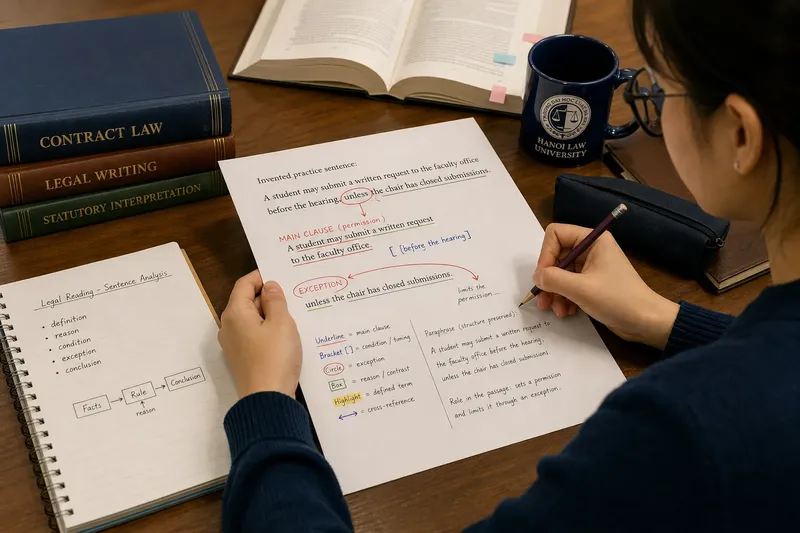
Make a short record with four fields: the term, what the wording includes, any express exclusions, and the provision where the term appears. Add a note about the definition’s stated reach. For each observation, make a decision about how far your reading can go:
- Find the term: Check the interpretation section and the provision where the term appears. If the document defines it, copy the wording accurately; if not, mark “no definition located” and do not supply one from memory.
- List what is named: Record each person, object, or activity the definition identifies. If the text names a clear category, use that wording in your notes; if it leaves the category unclear, mark the boundary as unresolved.
- Check for exclusions: Note anything the text expressly leaves out. If the case you are considering matches an exclusion, apply that limit to this reading; if none is stated, do not invent one, and describe the remaining question as open.
- Record the setting: Look for language limiting the definition to a document, section, subject, or purpose. If a limit is explicit, keep your interpretation within it; if the reach is unclear, avoid extending the definition beyond the text you can explain.
- Compare the category with the provision: Ask what distinction the provision makes between those inside and outside the category. If the distinction fits the wording, explain that connection; if it seems in tension with the text, flag the tension for class discussion rather than silently revising the definition.
- Separate text from inference: Label what the document states and what you infer about an unlisted case. If that inference could affect an actual right, duty, or dispute, consult a qualified legal professional; otherwise, present it as a classroom interpretation.
What do “means” and “includes” tell you?
Words such as “means,” “includes,” and “does not include” can help describe how a definition is framed. They do not determine its legal effect on their own. The complete wording and applicable rules of interpretation matter, so treat these words as prompts to examine the category rather than as shortcuts to an answer.
Imagine an invented course handout that defines “course material” as “required readings, including the case extracts listed in the weekly schedule.” A student has two items before them: one scheduled case extract and one lecture slide that is not listed. The student records the extract as named by the definition and marks the slide’s status as unresolved. The resulting reading identifies what the sentence covers without claiming that every unlisted item is excluded.
Which questions help clarify a legal definition?
Does a definition apply throughout a document?
It may, but a document can limit a definition to a section, subject, or purpose. Record any stated limit and avoid assuming broader reach when the wording does not establish it.
Does “includes” settle whether a category is open?
No. The word can suggest that named items are being added, but its effect depends on the complete definition and applicable interpretive rules. Describe what the text names and identify any boundary it leaves unresolved.
What if ordinary usage differs from the defined meaning?
Keep the two senses separate: one belongs to the document’s stated category, while the other belongs to general conversation. Use the document-specific meaning only within the reach its wording supports.
When should a student seek legal advice?
If an interpretation could affect an actual legal obligation, dispute, or decision, classroom analysis may not be enough. A qualified legal professional can assess the complete instrument and the law that applies.
How does a worked reading clarify the boundary?
Say you are studying an invented campus rule that defines “visitor” as a person entering university premises who is neither enrolled nor employed there. The rule uses that term for a reception check-in requirement. The case before you is a guest lecturer employed by the university. Apply the wording: the person enters the premises, but the definition excludes employees. For this invented rule, the answer is that the lecturer does not fall within the stated “visitor” category for that check-in requirement. The tradeoff is that this reading answers only the question posed by this definition; it does not settle what another campus rule might require.
For a legal definition at HLU or in another classroom, write down what the text names, any express exclusions, and the provision where the term operates. Then mark unresolved cases as inferences rather than settled wording. If a real legal consequence turns on the answer, take the complete document to a qualified legal professional.