Plan a First Case Discussion in Three Passes
Plan a first case discussion with a clear legal question, a map of the decision’s reasoning, and an open prompt that keeps classroom debate grounded in the text.

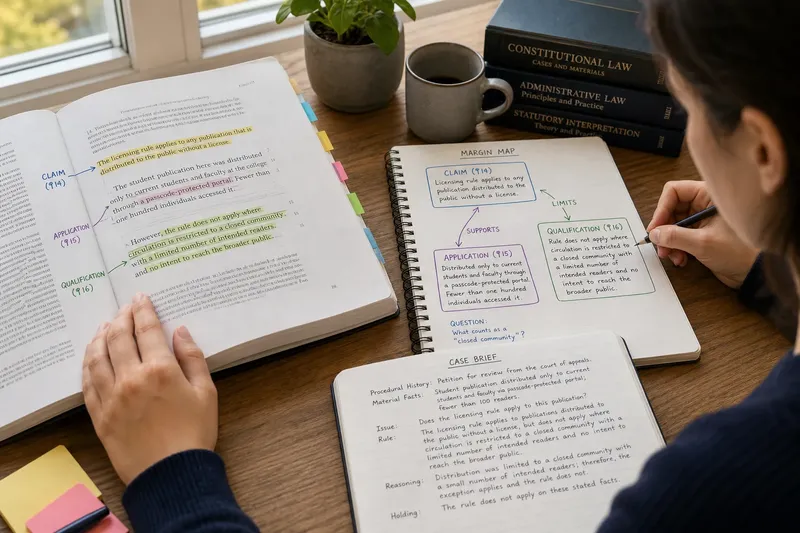
A student at Trường Đại học Luật Hà Nội opens a printed judgment and highlights several passages. A classmate asks what the decision-maker had to decide. The highlighter stops. Planning a first case discussion starts with a simple task: help students identify the issue, trace the explanation, and prepare a text-based question.
The aim is not to make every student reach the same view. It is to give the group a shared route through the material, so that disagreement can refer to the same question and passages.
What should students be ready to explain?
Before class, decide what students should be able to say about the assigned case. For a first discussion, keep the target narrow: name the decision at stake, state the question the decision-maker addressed, and describe how the decision-maker connected a rule to the facts.
Choose a short, self-contained judgment or a teacher-written case that provides enough context to follow the explanation. If important terms or procedural details are unfamiliar, define only what students need for the reading task. Avoid adding background that does not help them identify the issue or follow the reasoning.
Prepare three prompts for your own planning: What decision is being challenged? Where does the text state the relevant rule or standard? Which facts or arguments does the decision-maker treat as important? These prompts keep preparation centered on the discussion rather than on collecting every detail in the file.
How do you write a neutral legal question?
A legal question identifies the decision at stake and the rule or standard that matters. It is narrower than a general topic such as fairness, but it does not assume which side should win.
Imagine an invented classroom case in which a neighborhood group challenges a city permit decision. The packet includes a stated rule, the group’s objection, the city’s explanation, and a reviewing body’s decision. This is a made-up teaching situation, not a real dispute or a statement of Vietnamese law.
For that packet, “Was the city unfair?” is too broad. “Did the reviewing body have grounds under the rule in the packet to uphold the permit decision?” gives students a more useful task while leaving the answer open.
- Check whether the packet identifies the decision being challenged; if it does, write that decision in plain language, but if it does not, ask students to locate the decision-maker’s task before drafting an issue.
- Check whether the relevant rule or standard appears in the text; if it does, mark its wording, but if it does not, identify the gap rather than supplying an assumed rule.
- Check which fact or disagreement makes applying the rule difficult; if one is clear, connect it to the rule, but if none is clear, reread the parties’ competing claims before settling on a question.
- Check whether the draft question presumes a preferred answer; if it does, revise it so both outcomes remain possible, but if it is neutral, keep it visible during discussion.
- Check whether a student’s claim points to a passage; if it does, examine how the passage supports the claim, but if it does not, ask the student to reread before treating the impression as textual evidence.
- Check whether a comment addresses the stated issue; if it does, invite the student to explain its connection, but if it shifts to a wider policy debate, note the shift and return to the case question.
Keep the final wording on the board or in a shared document. Students can then tell whether a comment answers the question, challenges its framing, or moves beyond the assigned case.
How can students trace the decision’s reasoning?
The outcome is what the decision-maker decided. The reasoning is the explanation for that decision: the rule considered, the facts treated as important, and the connection drawn between them. Ask students to keep those parts separate rather than treating the result as the whole decision.
On the board, make two columns: “What the decision-maker decided” and “Why.” Students can add brief notes and point to the passages behind them. A statement of the result belongs in the first column; an interpretation of the rule, an assessment of a fact, or a response to an argument may belong in the second.
Say a student argues, “The permit should have been denied because the decision was unreasonable.” Ask which part of the explanation supports or weakens that view. The student might point to the stated rule, a fact in the packet, or an objection the decision-maker did not address. The claim is now specific enough to examine against the text.
This separation also helps students say what they disagree with. A student may accept the result but question the explanation, or understand the reasoning while preferring another result. Ask them to name the part they are evaluating and support that view with the assigned material.
What questions do instructors often ask about a first case discussion?
How is a legal question different from a broad topic?
A broad topic names an area of concern, such as local permits. A legal question identifies the decision and the rule or standard involved, while leaving the answer open.
What if the packet does not state the rule clearly?
Have students identify the uncertainty and point to the wording or missing information that creates it. Unless the class is explicitly testing an assumption, do not ask them to fill the gap with an unstated rule.
How can I bring discussion back to the text?
Ask which passage supports a claim and how that passage answers the question on the board. If the discussion has shifted to a broader policy issue, acknowledge the shift and return to the assigned decision.
Can students disagree with the decision-maker?
Yes. Ask students to distinguish their own view from the decision-maker’s explanation and to support their disagreement with details from the case.
How do the three passes work together?
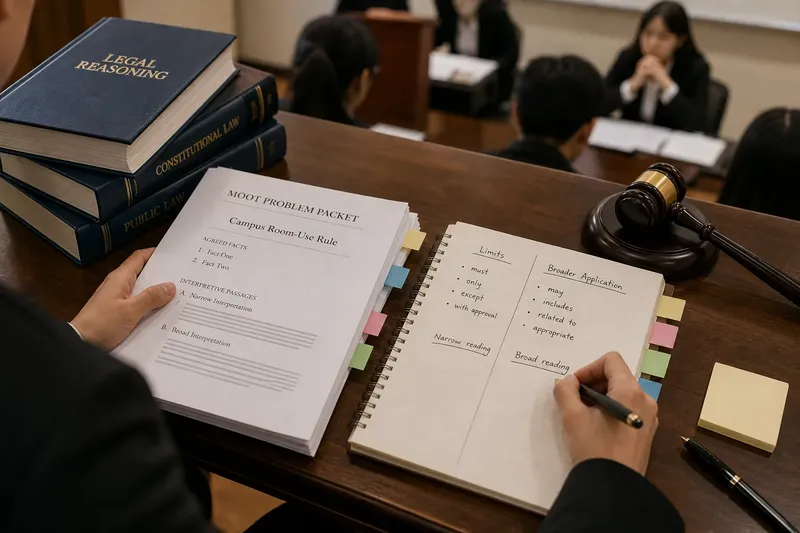
Use the same sequence throughout the discussion: frame the issue, trace the reasoning, and invite a focused question. The sequence is a teaching aid, not a fixed schedule; give each part the attention the material requires.
- Frame the issue. Ask students to identify the decision at stake, locate the rule or standard, and phrase a neutral legal question.
- Trace the reasoning. Separate the outcome from the explanation, then identify the rule, facts, and arguments the decision-maker uses.
- Open inquiry. Ask students to raise a question about the reasoning that can be discussed with reference to the case.
For a fully worked imagined example, suppose the invented permit packet contains four items: one rule, one objection from the neighborhood group, one explanation from the city, and one reviewing decision. First, students write the challenged action as “the city’s permit decision.” Next, they copy the rule’s wording without adding a new standard. Then they place the group’s objection and the city’s explanation beside the reviewing body’s response. Finally, they ask whether the response addresses the objection under the stated rule. The observable result is a set of notes that distinguishes the decision, the explanation, and an open question; if the packet does not supply enough text to answer that question, the class records the missing information instead of guessing.
A useful closing task is for each student to write one sentence stating the legal question, one describing the decision-maker’s reasoning, and one asking a question about that reasoning. If a sentence repeats the outcome without identifying an issue or explanation, send the student back to the relevant passage.
When planning a first case discussion, keep the legal question visible as students move from the decision to its explanation. That small practice helps the class distinguish an objection to the result from a question about how the decision-maker applied a rule.